
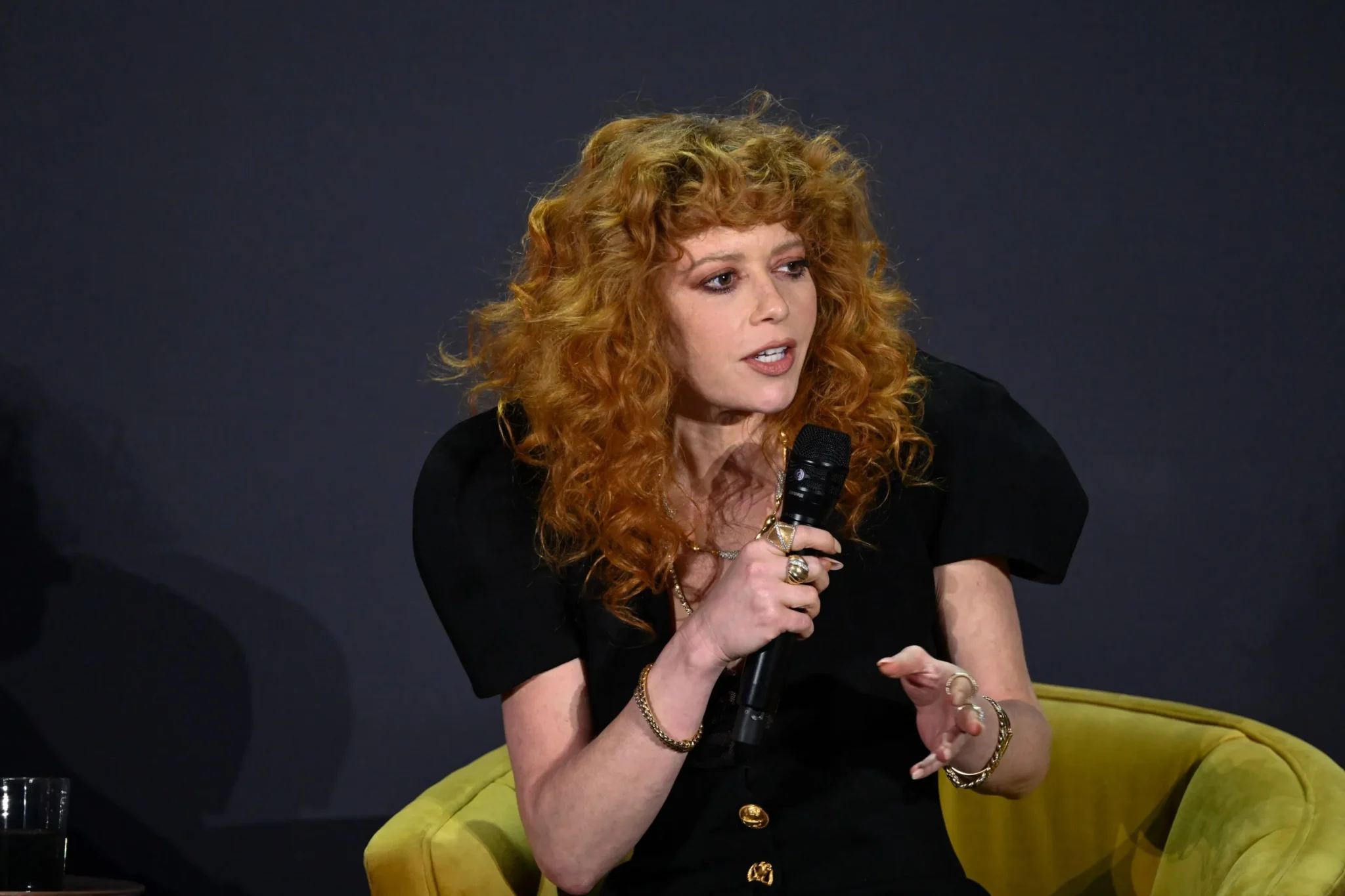
Natasha Lyonne, known for her distinctive voice and roles in “Russian Doll” and “Poker Face,” is now navigating a different kind of frontier: artificial intelligence. While she openly admits to a lifelong fascination with technology, envisioning interstellar travel and even a future where she might walk a red carpet as a reanimated cyborg, her current focus is far more grounded and critical. Lyonne, 46, recently voiced a significant concern to the Fortune Brainstorm AI audience in San Francisco: why, amidst AI’s boundless potential, is the primary application seemingly centered on replacing screenwriters rather than tackling pressing global issues like ocean plastic pollution? Her blunt assessment, delivered with her characteristic New York City inflection, was that this trend is no accident, but rather a cost-cutting measure.
As co-founder of the media production company Animal Pictures, Lyonne champions the idea of fair compensation for expertise, creative labor, and original ideas. She advocates for a democratization of filmmaking, aiming to dismantle the traditionally formidable barriers to entry that have long characterized the industry. Her message to C-suites and AI leaders is a direct challenge to deeply consider the human element in an age dominated by artificial intelligence. “We are the ones who are deciding what this use is going to be and how we choose to use it,” Lyonne stated, emphasizing a desire for AI to create more opportunities, granting more individuals a “seat at the table to do even more extraordinary things.” Her influence in this space was recently recognized by *Time*, which included her in its “100 Most Influential People in AI 2025” list.
Lyonne, who playfully appointed herself CEO of Animal Pictures and updated her LinkedIn profile because it “seemed like a vibe,” observes a growing chasm between senior executives making pivotal AI implementation decisions and the employees whose livelihoods and career paths could be jeopardized. She acknowledges external pressures, such as competition with China and Wall Street’s expectations, but insists that the industry must not lose sight of the profound ethical and societal implications of its choices. These, she contends, are decisions that history will ultimately judge.
Having been immersed in the film business since childhood, Lyonne understands the intricate human ecosystem that sustains the industry. She points out the immense collective effort—from actors and crews to drivers and the creative minds—required to bring stories to screens. The practice of AI companies scraping content without permission or payment, she argues, fundamentally disregards this entire network. “I don’t think it’s super-kosher copacetic to just kind of rob freely under the auspices of acceleration or China, right?” she questioned, underscoring the ethical quandary.
Lyonne is not merely an outspoken critic; she is also actively shaping alternative models. She co-founded Asteria Film Co., a generative AI film and animation studio that stands out by utilizing a “clean AI model.” This designation signifies that Asteria’s AI is trained on creative work that has been properly licensed or cleared, a stark contrast to systems that rely on unsanctioned content. Furthermore, Lyonne is directing an upcoming film titled “Uncanny Valley,” which employs an AI video model called Marey. This model, notably, was developed using copyright-cleared, licensed data. The film itself promises a blend of generative AI filmmaking techniques with traditional human-led processes, though it will not feature AI actors.
Her unique perspective on complex systems, she notes, dates back to her childhood studies of Talmudic texts and interpretations in Aramaic. This early immersion in exploring layers of meaning and theoretical iterations now informs her approach to AI in filmmaking. Lyonne recounts dropping out of New York University to pursue a self-directed film education at the indie movie house Film Forum. When asked what advice she would offer her younger self, she stressed the importance of mastery—the kind that takes 10,000 hours to achieve. “Really, really learn these tools,” she advised, emphasizing that true technique takes considerable time to develop. For Lyonne, the ultimate goal of mastering a skill is not rigid adherence, but the freedom to then creatively break the rules. Her ambition, she concludes, is not to “rage against the machine,” but rather to construct “new houses, new seats at the table” within the evolving landscape of technology and creativity.