
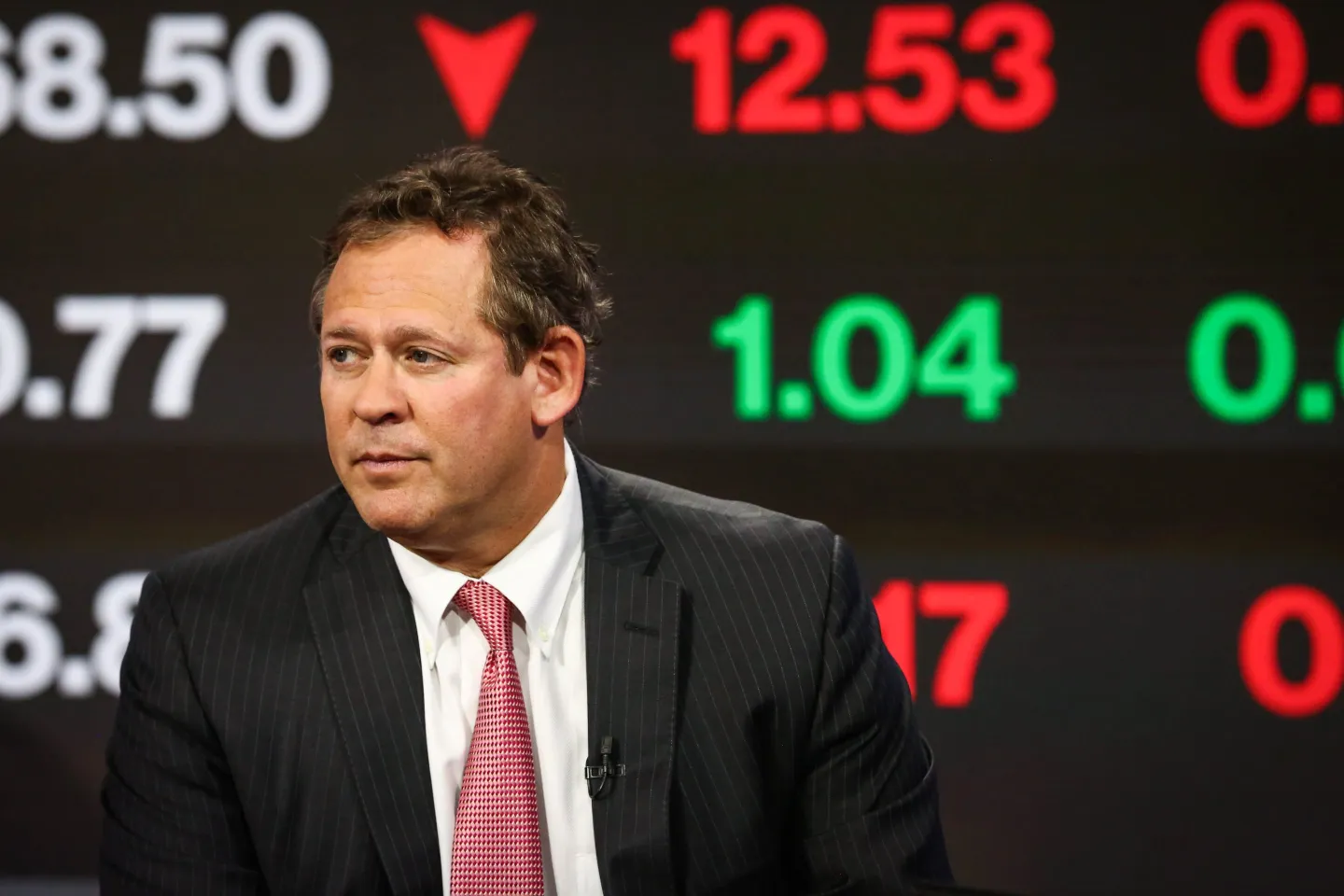
Rick Rieder’s career trajectory, from a self-described “motivationally challenged” student to overseeing $2.3 trillion in global bond markets at BlackRock, offers a compelling narrative of transformation driven by an almost pathological obsession with data and risk management. This intense focus, cultivated since his elementary school days betting lunch money on Oakland Raiders games, now positions him as a surprising, yet increasingly prominent, candidate to lead the U.S. Federal Reserve.
His early life was far from a clear path to financial titan. Rieder admits to being a mediocre high school student, struggling with subjects like history and literature, finding logic only in accounting. The turning point arrived during his freshman year at Hobart College, after receiving dismal grades that placed him on academic probation. A four-hour contemplation on a golf course rock in Scarsdale, New York, catalyzed a fundamental shift. He recognized a stark contrast between his own aimlessness and his entrepreneurial father’s relentless effort to keep his office products company afloat amidst technological disruption. This realization spurred him to overhaul his life, transfer to Emory University, and immerse himself in business studies, finding a curriculum that mirrored his innate wiring.
Rieder’s unique approach to risk and return was further refined during his MBA at Wharton. He recounts a casino executive explaining that casinos win not merely because the odds favor the house, but because gamblers eventually lose their limited funds and are forced to leave, while the house possesses infinite liquidity and time. This insight, that survival in any game, especially financial markets, hinges on staying in long enough to let trends play out, became a foundational principle. It was about avoiding the “down 200” moment, the point of no return where one is forced to exit. This philosophy has guided his institutional survival through two major financial meltdowns. He joined E.F. Hutton in 1987, just months before Black Monday, and later departed Lehman Brothers in May 2008, narrowly preceding its historic collapse, to found his own firm, R3 Capital. BlackRock’s acquisition of R3 a year later cemented his position at the helm of the world’s largest investment platform.
Colleagues describe Rieder as a man who “doesn’t sleep,” often sending emails at 3 AM and staying in the office longer than anyone else. This relentless work ethic, fueled by what he admits is acute anxiety about being out of sync with market movements, is intertwined with his data-driven methodology. He meticulously tracks biometric data, noting his stress levels peak when he’s forced to disconnect from markets. This constant vigilance is crucial in the fixed income world, where the objective is not necessarily to chase exponential gains like in equities, but to meticulously manage vast sums of debt against threats like inflation and interest rate fluctuations, aiming to “make a little bit of money a lot of times.”
The prospect of Rieder leading the Federal Reserve has generated considerable discussion, particularly given his lack of prior experience within the institution, a stark contrast to other contenders like the “Two Kevins,” Hassett and Warsh. Some, like former Trump advisor Stephen Moore, have called his candidacy a “curveball.” Yet, those who have witnessed his career, including Josh Tarnow, a former BlackRock managing director who has observed Rieder for three decades, believe his temperament and forward-looking approach are precisely what the Fed needs. They contend that his ability to remain calm under pressure and his perpetual quest for truth, even in high-stakes meetings with powerful figures, make him uniquely suited for the immense responsibility of guiding the U.S. economy.
Rieder’s colleagues point to his humility and commitment to others as defining characteristics. Despite managing a colossal sum of money, he is known for being a listener rather than a talker, always seeking different opinions. His involvement with charitable endeavors, such as serving on the board of Uncommon Schools for two decades, further illustrates a personality that prioritizes service over self-aggrandizement. The central question remains whether a man whose life is so intrinsically linked to the immediate pulse of financial markets can adapt to the more deliberative, politically charged environment of the Federal Reserve, where the focus shifts from personal gain to national fiscal well-being. His long-standing mantra, “It’s not about being right, it’s about making money,” would need to evolve significantly. However, some close to him suggest the role could be “freeing,” allowing him to apply his data-driven intellect to a broader set of variables, ultimately serving the country’s economic health rather than just a portfolio.