

Uber is accelerating its push into autonomous logistics, announcing a landmark partnership with Starship Technologies that will bring robot-based deliveries to European cities for the first time. The initiative marks a major milestone not only for Uber’s evolving delivery ecosystem, but also for Europe’s growing embrace of automated urban mobility.
- A Strategic Alliance for the Next Stage of Delivery
- How the Robot Deliveries Will Work
- Europe: A Prime Testing Ground for Autonomous Delivery
- Impact on the European Delivery Ecosystem
- 1. Lower Delivery Fees
- 2. Reduced Traffic and Emissions
- 3. Increased Reliability and Speed
- 4. Pressure on Competitors
- Challenges Ahead: Regulation, Infrastructure, and Public Sentiment
- A Glimpse Into the Future of Autonomous Commerce
- Conclusion: A Major Leap Toward Fully Autonomous Urban Logistics
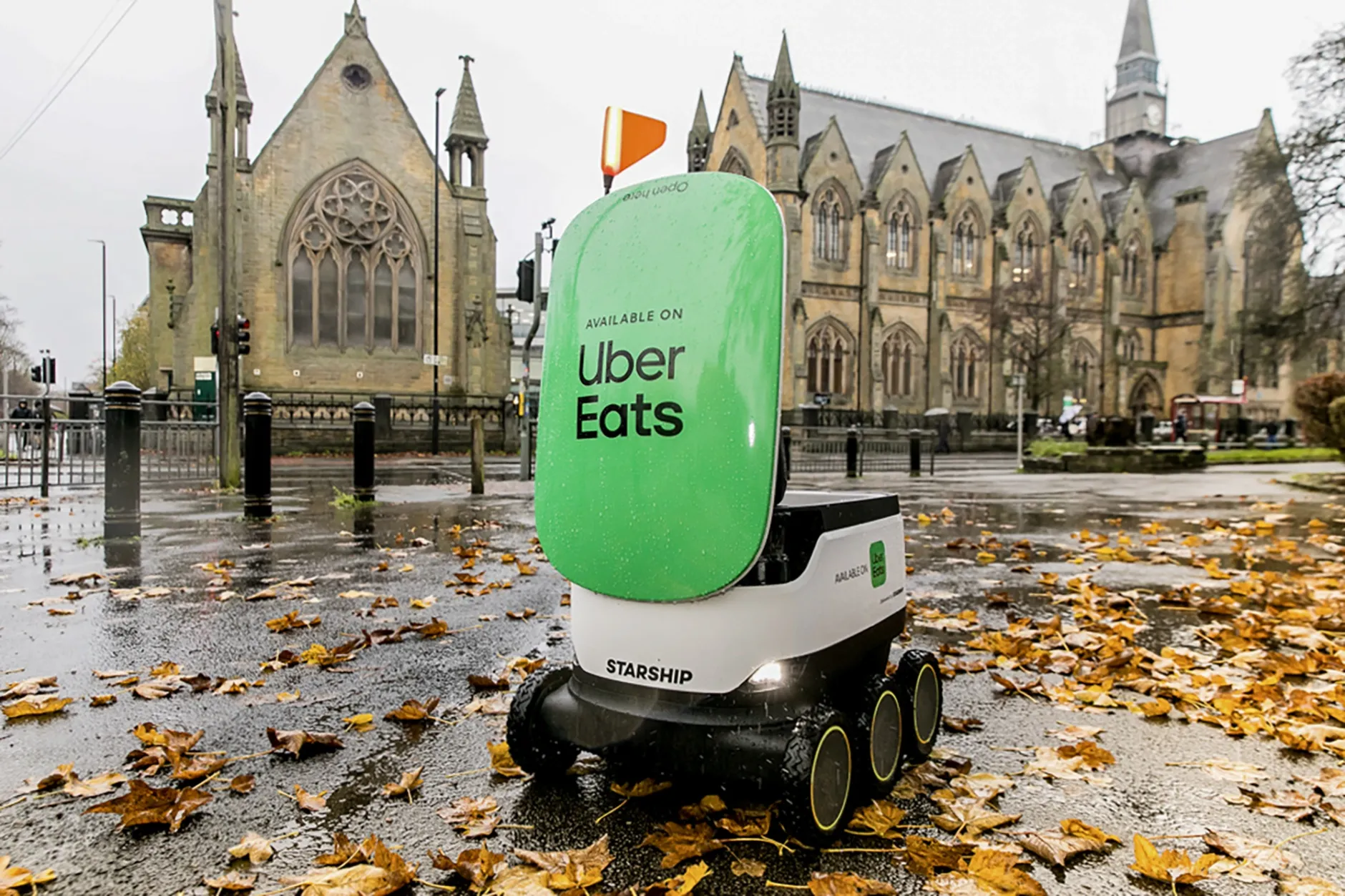
The collaboration will integrate Starship’s fleet of compact, six-wheeled delivery robots directly into the Uber Eats platform, allowing customers to order food and small goods for fully autonomous doorstep delivery. The move signals the beginning of a new era for last-mile logistics in Europe—one defined by automation, efficiency, and low-emission transport.
A Strategic Alliance for the Next Stage of Delivery
Uber Eats has grown into one of the most widely used food delivery platforms in Europe, but competitive pressures, rising labor costs, and tightening environmental regulations have spurred the company to explore automation as a long-term solution. Starship Technologies, known for pioneering real-world robot deliveries on university campuses and suburban neighborhoods, brings extensive operational experience to the partnership.
For Uber, the alliance offers:
- A scalable, cost-effective delivery method
- Faster and more predictable arrival times
- Reduced reliance on human couriers
- Enhanced positioning in a competitive European market
- Compliance with increasingly strict sustainability and emissions targets
For Starship, the partnership represents a powerful expansion channel, granting access to millions of urban customers across multiple European countries.
How the Robot Deliveries Will Work
Customers using the Uber Eats app will soon be able to choose “robot delivery” if their address falls within designated service zones. After placing an order, a Starship robot will autonomously navigate sidewalks and pedestrian routes to the restaurant, collect the order, and travel to the customer’s location.
Key features include:
- Autonomous Navigation: Robots equipped with sensors, cameras, radar, and GPS create real-time maps of their surroundings.
- Secure Cargo: The robot’s locked compartment can only be opened by the customer via the Uber app.
- Eco-Friendly Transport: Fully electric, low-noise, zero-emission machines designed for dense urban areas.
- Remote Monitoring: Starship headquarters can monitor robots and intervene if needed.
The robots travel at pedestrian speeds, making them safe and compliant with European urban design standards.
Europe: A Prime Testing Ground for Autonomous Delivery
Europe has become an attractive region for piloting autonomous delivery systems due to its compact cities, sustainability priorities, and government-backed digitalization initiatives. Countries like the UK, Germany, and Estonia already host small-scale autonomous delivery programs—many of them operated by Starship itself.
Uber’s entrance into this space amplifies the trend, potentially accelerating adoption across major European capitals and secondary cities.
Market analysts point to several factors supporting rapid expansion:
- High labor costs increase the appeal of automation.
- Green mobility policies encourage low-emission delivery alternatives.
- Urban density makes short-range robot deliveries viable and efficient.
- Consumer acceptance of automation is growing due to exposure to AI, drones, and autonomous vehicles.
Impact on the European Delivery Ecosystem
The Uber–Starship partnership has the potential to reshape logistics infrastructure, delivery economics, and consumer expectations.
1. Lower Delivery Fees
Autonomous robots can operate at a fraction of the cost of human couriers, allowing Uber to offer lower delivery fees—a key competitive advantage in price-sensitive markets.
2. Reduced Traffic and Emissions
Replacing cars and scooters with electric robots supports municipal goals to reduce congestion and pollution.
3. Increased Reliability and Speed
Robots avoid many delays associated with human couriers—traffic, mistakes, or route inefficiencies.
4. Pressure on Competitors
Major delivery companies such as Deliveroo, Bolt Food, Just Eat Takeaway, and Glovo may be forced to accelerate their own automation strategies to avoid falling behind.
Challenges Ahead: Regulation, Infrastructure, and Public Sentiment
Despite optimism, several hurdles remain.
Regulatory Approvals
European nations vary widely in their rules governing sidewalk robotics. Uber and Starship must secure approvals city-by-city.
Urban Infrastructure
Narrow sidewalks, uneven pavement, and crowded pedestrian zones pose obstacles to smooth robot movement in older European cities.
Public Perception
While many view robots as innovative and eco-friendly, concerns persist about:
- Pedestrian safety
- Job displacement
- Privacy and surveillance implications
Uber and Starship plan to engage with local communities to address these concerns proactively.
A Glimpse Into the Future of Autonomous Commerce
This partnership signals a broader transformation of urban life. Autonomous systems—robots, drones, and AI-driven vehicles—are poised to redefine how goods move through cities. Robot deliveries may soon extend beyond food to include groceries, packages, pharmaceuticals, and government services.
Uber envisions a diversified delivery fleet: human couriers, bikes, electric mopeds, autonomous cars, drones, and ground robots operating together in an integrated ecosystem.
Conclusion: A Major Leap Toward Fully Autonomous Urban Logistics
The launch of robot deliveries in Europe marks a turning point for Uber and the continent’s rapidly evolving delivery landscape. By joining forces with Starship Technologies, Uber is signaling that the future of last-mile logistics will be autonomous, sustainable, and increasingly efficient.
If successful, this initiative could reshape Europe’s urban transport systems and set the global standard for fully automated on-demand delivery.