
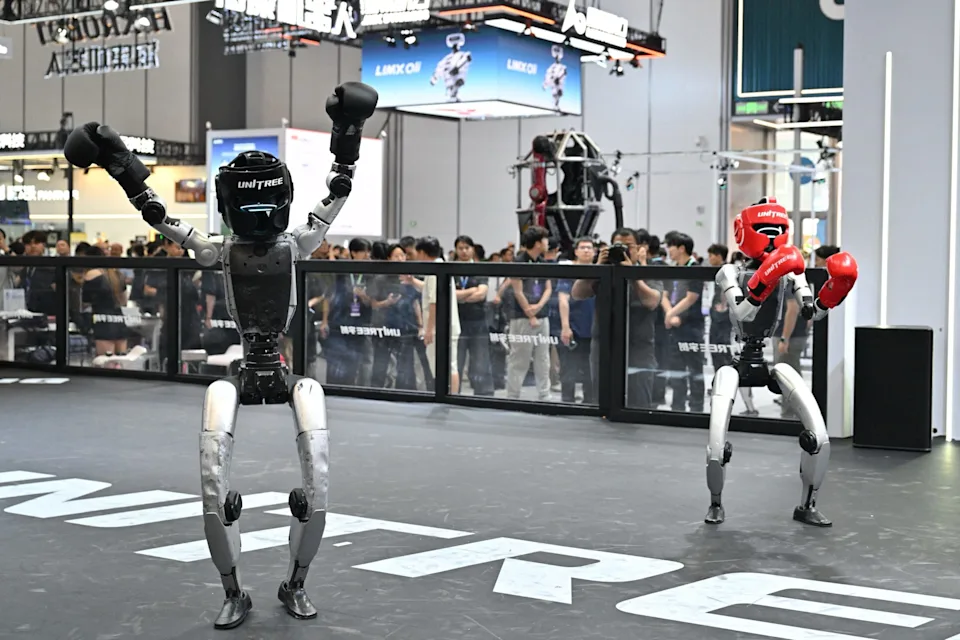

The Shanghai STAR Market witnessed an extraordinary debut this week as shares in Unitree, the Chinese robotics firm widely recognized for its synchronized dancing humanoids, soared by more than 460% on their first day of trading. This dramatic surge propelled the company’s valuation to an estimated $66 billion, positioning it significantly ahead of its American counterparts, including Figure AI, which recently secured a $39 billion valuation in a September 2025 funding round. The immediate investor enthusiasm underscores a burgeoning confidence in China’s rapidly advancing robotics sector, even as complex geopolitical and technological headwinds gather.
Unitree, founded in Hangzhou in 2016, raised approximately $900 million in its initial public offering, initially valuing the company at $9 billion. This meteoric rise places it beyond the market capitalization of established Chinese tech giants like Baidu and JD.com. The company’s journey from a startup to a national champion has been swift, marked by its humanoid robots becoming a staple at high-profile events such as the CCTV Spring Festival Gala. Founder Wang Xingxing even garnered a rare invitation to meet with Chinese President Xi Jinping in 2025, alongside other prominent figures like Alibaba’s Jack Ma. This kind of state endorsement, coupled with backing from DeepSeek, Alibaba, Ant Group, Tencent, and various state-backed investment funds, signals deep institutional support for Unitree’s ambitions.
Last year, Unitree reported robust financial figures, with revenues reaching 1.7 billion yuan ($252 million) and profits of 600 million yuan ($89 million). Nearly 45% of this revenue originated from overseas markets, highlighting the company’s international reach. While a significant portion of its sales currently supports research initiatives, there is a growing trend among Chinese tech firms and state-owned enterprises to integrate these humanoid robots into their operational frameworks. The company’s rapid product iteration and continuous innovation were cited by Nomura analysts, who issued a “buy” rating, as foundational to its “first-mover advantage.” Just days prior to its listing, Unitree unveiled its “Superman” robot, claiming it could surpass human records in jumping height and running speed, further demonstrating its technological prowess.
However, the path forward is not without considerable challenges. Analysts hold mixed views on the long-term potential for companies like Unitree. While the firm has pushed the boundaries of robotic capabilities, persistent struggles on the software development front remain a concern. More critically, a recent U.S. ban on foreign-made robots, citing national security risks, could significantly impact Unitree’s revenue growth. The U.S. market accounted for 18% of Unitree’s revenue last year, and losing access to this substantial customer base could also deprive the company of valuable feedback essential for product improvement. The Pentagon’s decision to list Unitree among “Chinese military companies” further complicates its international standing.
Despite these hurdles, the enthusiasm surrounding Chinese IPOs on the mainland remains palpable. Regulators often aim to keep initial valuations conservative, potentially leading to substantial first-day jumps once trading commences. This phenomenon was also observed with ChangXin Memory Technologies (CXMT), which saw its shares surge by 460% on its debut in July, eventually becoming China’s most valuable company. For the U.S. robotics sector, the ban on Chinese components presents a different set of challenges. Without access to potentially more affordable Chinese robots and parts, American startups might face increased difficulties in developing and manufacturing cost-effective products, with some reportedly resorting to carrying Chinese components in their luggage to circumvent restrictions.
As Unitree navigates this intricate landscape, its valuation, now surpassing many established firms, undeniably signals a pivotal moment for China’s robotics industry. Yet, the question of whether the current surge in humanoid robot shipments is sustainable, particularly without significant advancements in AI model capabilities, continues to be debated by market observers. HSBC analysts, for instance, have expressed skepticism, suggesting that the “upcycle is unlikely to be sustained over the next 1-2 years” in the absence of such improvements. The company’s journey will serve as a critical barometer for the broader trajectory of advanced robotics globally.