


Eduard Gevorkyan did not set out to build software. He set out to solve a problem he watched play out the same way, in every industry, in every market he worked in: the people who are best at their craft are almost never the people who are best at running the business around it.
A hairstylist who trained for a decade loses clients because she cannot reply to WhatsApp messages fast enough. A personal trainer with a full client roster spends his evenings chasing invoice payments. A real estate agent misses a lead because she was in a property showing when the inquiry came in. The skill is not the problem. The infrastructure around it is.
That gap — between what service professionals are exceptional at and what running a business actually demands — is what Halper AI was built to close.
The path to founding Halper was not linear. Gevorkyan studied biochemistry and genetic engineering before pivoting into management consulting at McKinsey and Company, where he learned how organizations break under the weight of their own administrative complexity. From McKinsey he moved to Google, where he served as Head of Strategy and Operations — a role that gave him a direct view of what it means to build products for hundreds of millions of users whose needs are vastly different from one another.
The lesson he took from Google was deceptively simple: the gap between what you think your user needs and what they actually need in their daily life is enormous. Most software is built for the idealized user. Halper was built for the real one.
Before founding Halper, Gevorkyan applied that philosophy to SoulsHub, an AI platform that allowed users to interact with licensed AI-powered replicas of public figures — coaches, mentors, and thought leaders — via chat, voice, video, and augmented reality. The platform scaled to around 100 AI personalities and demonstrated something that would directly inform Halper’s core technology: that AI, when done correctly, can communicate in a way that feels genuinely human. SoulsHub was acquired in December 2024 by a technology group headquartered in Saudi Arabia for an estimated $8 million.
The exit validated the technology. The question was where to apply it next.
The answer was not consumers wanting to talk to celebrities. It was the 582 million solopreneurs worldwide who spend more time answering the same WhatsApp messages than doing the work they trained for.
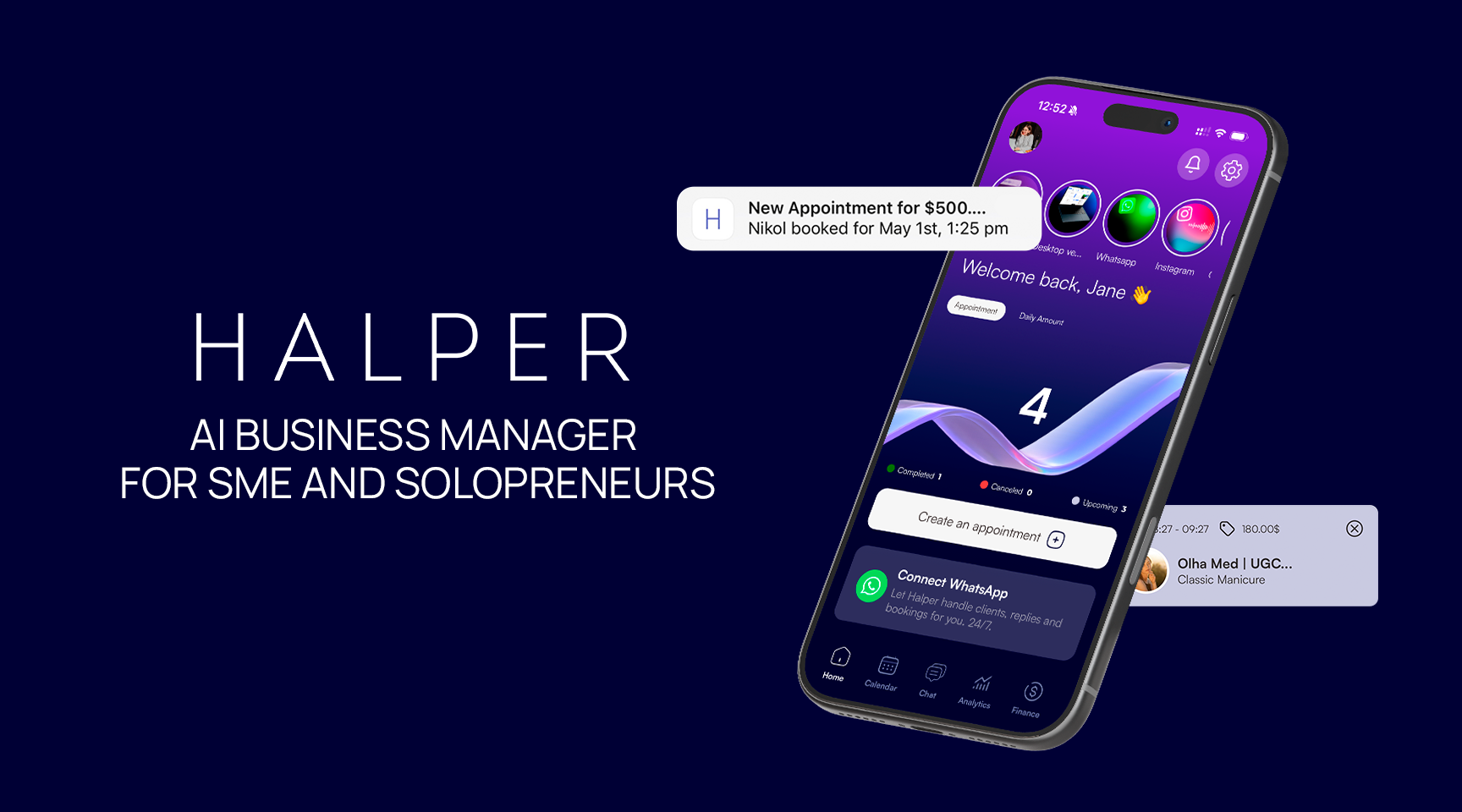
Halper AI launched in 2025, headquartered in Dubai, UAE, it connects directly to WhatsApp, Instagram, and Telegram — the platforms where most service business conversations actually happen — and manages client communication, appointment booking, invoicing, follow-ups, and CRM automatically, in the business owner’s own tone, 24 hours a day.
What separates Halper from every other automation tool in the market is not what it does but how it sounds doing it. The product reads and responds to voice messages, sends voice replies in the owner’s cloned voice, uses typing indicators before responding, splits replies into natural message sequences the way a real person would, and waits for the logical conclusion of a multi-message exchange before responding — a feature the team calls staking, which prevents the AI from interrupting a client mid-thought. Clients cannot tell they are talking to an AI. That is not a marketing claim. It is the single metric Gevorkyan measures the product against.
Setup takes three minutes. No developer, no flow builder, no scripts to write.
The institutional validation has followed. Halper AI is backed by NVIDIA Inception, Google for Startups, and AWS Activate, where it is ranked 4th among all featured startups globally. The company holds Official Meta Business Partner status and won the 2026 Global Recognition Award — selected from a field of over 15,000 applicants and evaluated alongside NVIDIA and Neuralink using the Rasch psychometric measurement model, scoring at the highest levels across Innovation, Leadership, Service, and AI and Research.
Award spokesperson Alex Sterling noted that Halper "exemplifies the kind of innovation we look for: technically credible, broadly accessible, and designed with the end user's real circumstances in mind."
The product currently serves over 10,000 business owners across the UAE, United States, LATAM, and Spain.
The philosophy Gevorkyan applies to the product is the same one he applies to building the company. He calls his success metrics freedom metrics. Most software companies measure engagement — daily active users, time spent in app, session length. Gevorkyan measures the opposite. He wants users to open Halper once and close it. He wants the product to be so functional that it disappears into the background of someone's business and frees them to do the work that actually matters.
That orientation — toward the user's freedom rather than their engagement — explains why Halper's NPS reached 4.4 in April 2026. It also explains the company's most recent move: expanding into healthcare. Physiotherapists, dental clinics, nutritionists, and private wellness practitioners are now being onboarded, bringing Halper into a vertical where the administrative burden is acute and the tolerance for error is low.
Gevorkyan's background in biochemistry and genetic engineering — fields where the smallest variable determines whether a system works or fails — shapes how he thinks about entering regulated environments. The healthcare expansion only happened after the NPS confirmed the product could be trusted with patients.
The AI business manager category is early. Most of the competition is either chatbot infrastructure that requires technical expertise to deploy, or enterprise CRM software designed for organizations with dedicated operations teams. Neither serves the solopreneur working alone from a phone.
Gevorkyan's thesis is that the tools that once required a full administrative team — communication management, scheduling, invoicing, client tracking — are now accessible to a one-person business at the price of a monthly subscription. The gap between a solo operator and a fully staffed operation, at least in terms of client experience and response speed, has effectively closed.