

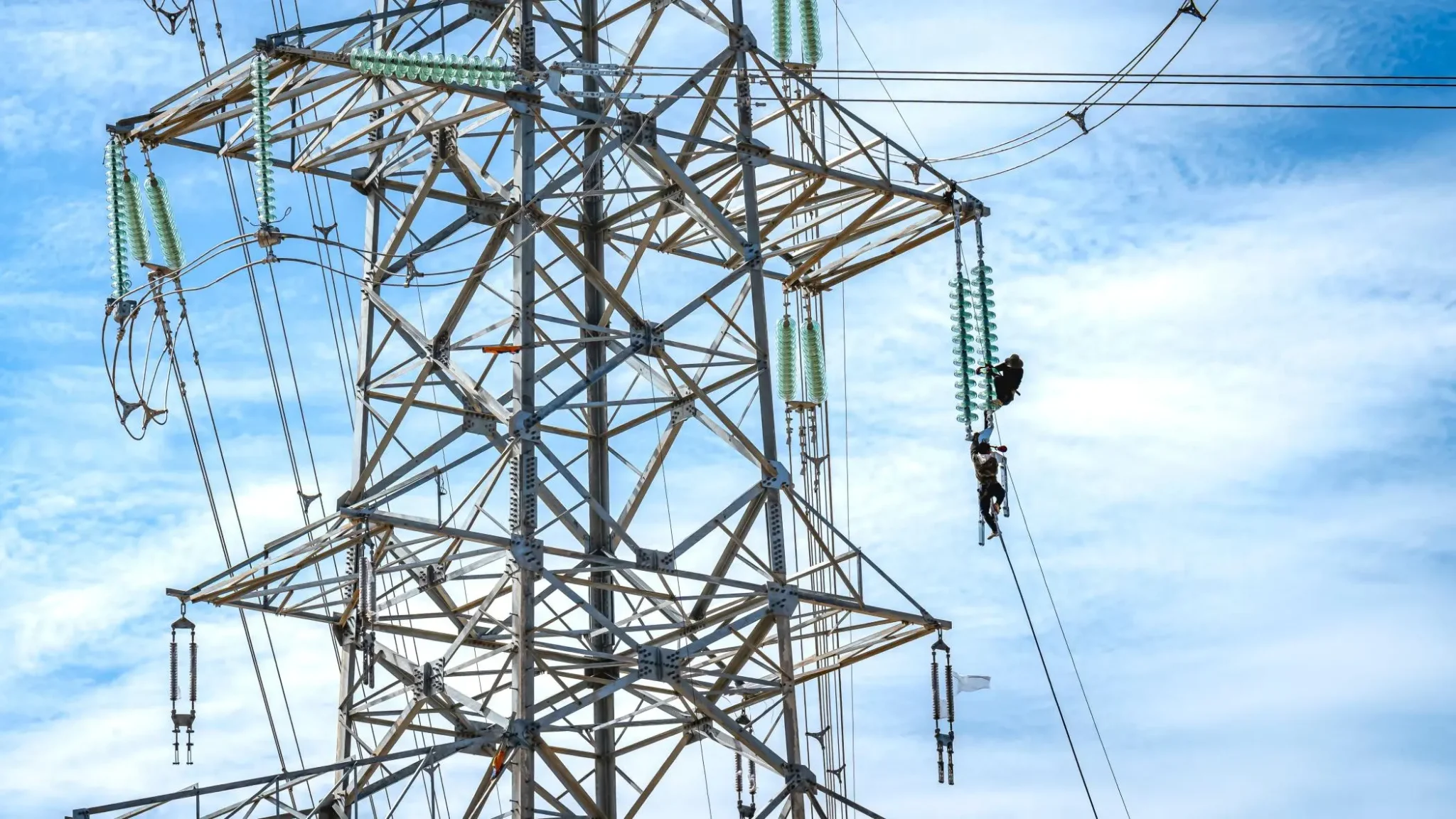

Workers maintain a high-voltage power transmission tower
The European Union’s proposed budget for 2028-2034 falls dramatically short of what the bloc actually needs to invest in, according to new analysis from the Bruegel think tank, which argues the current proposal would leave the vast majority of Europe’s investment gap unaddressed.
Bruegel researchers Zsolt Darvas, Costanza Greppi Maturana and Marie-Sophie Lappe found that for so-called European Public Goods, areas like cross-border energy networks and shared climate infrastructure, the proposed budget could close only 12% to 22% of the investment gap. Measured against Europe’s total investment needs across all priority areas, the EU budget might help cover just 4% to 8%, a shortfall the authors describe bluntly: “the proposed EU budget would cover only a fraction of Europe’s investment needs.”
Part of the problem is sheer scale. The EU budget currently amounts to just over 1% of EU gross national income, a figure the researchers note is “very small compared to what countries spend nationally” on their own domestic investment priorities. That structural mismatch leaves the EU-level budget poorly positioned to fund the kind of continent-spanning investment that no single member state can finance alone.
The areas most exposed by that gap read like a list of Europe’s biggest strategic priorities: the green transition alone is estimated to require hundreds of billions of euros annually, alongside major funding needs in digital technology and innovation, defence and resilience, and the cross-border energy networks needed to keep the green transition and climate goals on track.
Bruegel’s recommendations center on closing that gap directly rather than relying on financial workarounds. The think tank calls for increasing the budget by roughly 0.6% of GNI beyond what the European Commission has proposed, using existing spending flexibility to prioritize genuinely long-term European goals, and improving the quality of defense spending data so policymakers can actually track where investment gaps are worst. Crucially, the authors push back on the idea that clever financial engineering can substitute for direct public money: “Guarantee-based instruments…cannot replace direct public investment,” they write, a direct challenge to the assumption that loan guarantees and leveraged private capital alone can close a gap this large.