
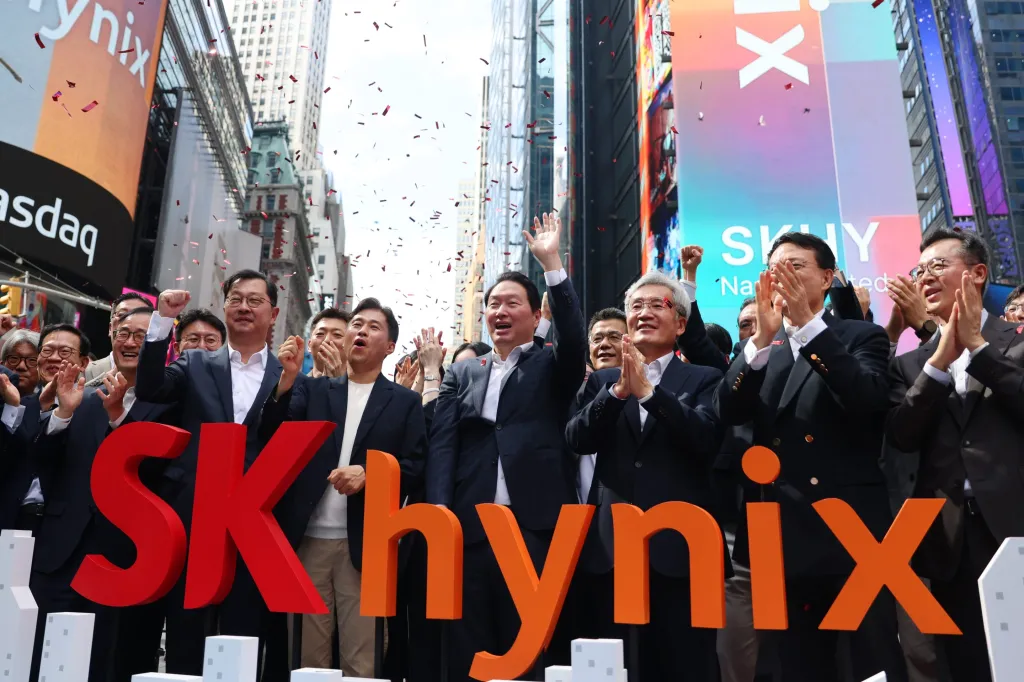

The recent Nasdaq listing of SK Hynix, securing $26.5 billion, stands as a notable event in financial markets, marking the second-largest share sale in US history. Trailing only SpaceX’s $86 billion IPO last month, this debut offers American investors direct engagement with a critical player in the artificial intelligence sector. Shares climbed 12.8% on their initial trading day, reflecting market enthusiasm for a company deeply embedded in the AI supply chain.
SK Hynix manufactures the specialized high-bandwidth memory (HBM) chips that are integral to most Nvidia processors, a component now commanding substantial prices amidst a global shortage. Chey Tae-won, Chair of SK Group, emphasized the intense demand, noting plans to double production capacity within five years, yet still falling short of customer needs. This reliance on SK Hynix’s specialized products underscores its pivotal role in the AI industry’s expansion.
The journey of SK Hynix to its current market position is rooted in a history of strategic development. Founded in 1983 as Hyundai Electronics, the company underwent significant transformation following the 1997 Asian Financial Crisis. After absorbing LG Semiconductor and renaming itself Hynix, it faced substantial debt, necessitating bailouts before being acquired by SK Group in 2012. A critical turning point arrived in 2013, when the company collaborated with AMD to develop the world’s first HBM chip. Despite HBM being a niche product at the time, SK Hynix’s sustained investment positioned it with a decade-long advantage over competitors like Samsung and Micron when the AI boom ignited demand for high-speed data processing capabilities. HBM’s ability to deliver significantly more bandwidth than conventional dynamic random-access memory (DRAM) made it indispensable for training large language models, cementing SK Hynix’s control over approximately 60% of the global HBM market by revenue.
Despite its global technological leadership, SK Hynix, like many South Korean companies, has historically contended with what is termed the “Korea Discount.” This phenomenon sees their shares trade at a lower valuation compared to international peers, sometimes even below book value. For instance, US chipmaker Micron Technology commands a $1.1 trillion valuation, despite SK Hynix’s superior profitability. Analysts often attribute this discount to the corporate governance practices of South Korea’s family-controlled conglomerates, or “chaebols,” which are perceived to prioritize group interests over shareholder returns. SK executives anticipate that the US listing will attract a broader base of global investors who may find direct access to the Korean market challenging, with HSBC analysts projecting a potential 20% uplift in the chipmaker’s valuation through the listing of American depository receipts.
The company’s financial performance reflects its strategic success, with SK Hynix reporting record revenues of 97.1 trillion won ($64.1 billion) in 2025 and a net income of 42.9 trillion won ($28.3 billion), translating to a robust 44% net profit margin. This financial strength has also positioned the company as a source of talent, exemplified by Intel’s recent appointment of Lee Seok-hee, former SK Hynix CEO, to lead its Foundry division. The company’s influence extends beyond its direct operations, significantly impacting the South Korean economy. Along with Samsung Electronics, SK Hynix accounts for over half of the KOSPI’s total market capitalization, contributing to its status as one of the world’s best-performing market indices, despite its inherent volatility.
The success of the AI sector and companies like SK Hynix is also reshaping societal dynamics in South Korea. In late 2025, SK Hynix agreed to allocate 10% of its annual operating profits to employee bonuses, with the initial payout averaging around 140 million won ($93,000) per employee. This profit-sharing model, also adopted by Samsung for its chip workforce, has elevated the stature of chip workers, with a common joke suggesting an SK Hynix jacket is a significant asset on a blind date. However, this trend has also raised concerns from the Bank of Korea regarding potential inflationary effects and prompted discussions on “worsening social division” due to the concentrated wealth within the chip industry. The South Korean government is examining ways to distribute the benefits of the AI boom more broadly, including exploring new investment vehicles backed by increased tax revenues from the booming profits of Samsung and SK Hynix. Despite these robust growth indicators, some analysts caution that the current memory shortage may not persist indefinitely, noting that the rapid expansion of production capacity could lead to future oversupply, echoing historical boom-and-bust cycles in the semiconductor industry.